Some links on this page are Amazon affiliate links. If you buy through them we may earn a commission at no extra cost to you. It does not change what we recommend.
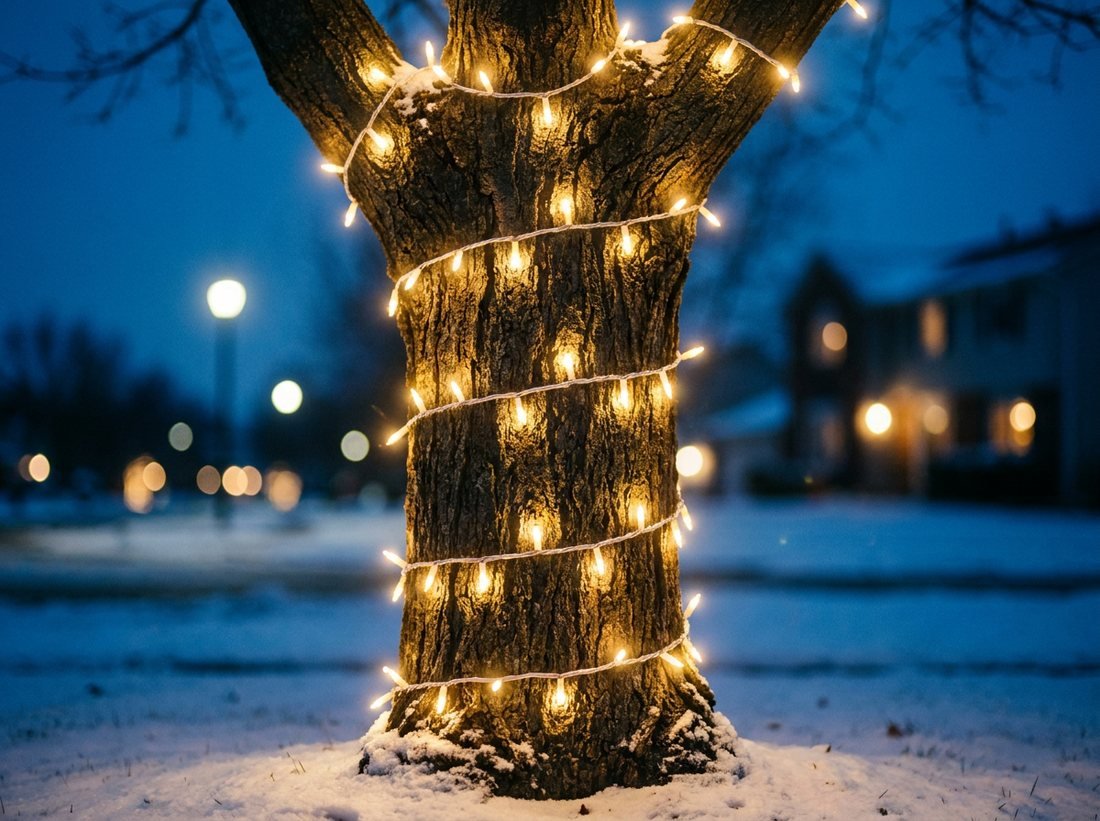
Wrapping a trunk is the one Christmas lighting job with an exact answer, because it is pure geometry rather than a rule of thumb. Almost everyone underestimates it, usually by a factor of three.
The arithmetic
Two measurements, one choice:
- Height you intend to wrap.
- Distance around the trunk — a tape measure round it, not the diameter.
- Gap you want between turns.
Then:
Turns = height ÷ gap String needed = turns × distance around
A worked example. An 8-foot height, a trunk 36 inches around, wrapped at 4-inch intervals:
- Turns: 8 ft = 96 in, ÷ 4 in = 24 turns
- String: 24 × 36 in = 864 in = 72 feet
Seventy-two feet, for eight feet of trunk. That is why the first attempt always runs out — people buy a 25-foot string and expect it to do the job.
Run your own numbers
The calculator does the arithmetic on this page for your own measurements — trees, rooflines, columns, railings, shrubs and windows.
Open the calculatorTrunks taper
A tree is not a cylinder. The figure above uses one circumference, and the real trunk is thicker at the bottom. Measuring at mid-height gives a decent average; measuring at the base overestimates and leaves you with spare string, which is the better error to make.
Where branches start, the maths stops applying altogether. If you intend to carry on out along the limbs, each one is its own tapering spiral, and the honest planning answer is to measure the trunk properly, then add half again for the lower branches.
Spacing, and what it looks like
No published source gives a correct gap, because there isn't one — it is a matter of taste. In practice:
| Gap | Effect |
|---|---|
| 2 in | Solid band of light; very dense, uses a lot of string |
| 3 in | Rich and deliberate; the usual choice for a feature tree |
| 4 in | Clearly lit, still reads as a spiral |
| 6 in | Sketched in; good over a long height on a budget |
| 8 in or more | Reads as sparse, and the spiral becomes the feature |
Halving the gap doubles the string. That one relationship is worth knowing before you choose: going from 4 inches to 2 inches turns the example above from 72 feet into 144.
The method
Measure first, buy once. Do the sum above, then add 10%.
Start at the bottom, plug end down. The plug needs to reach a socket, and the bottom of the trunk is where the socket is. Starting at the top means discovering the lead is in the wrong place after twenty-four turns.
Keep the string taut against the bark but not tight. Wrapped tight, the string cuts into the bark of a living tree and becomes very difficult to remove. Snug is enough — the spiral holds itself up.
Use one hand as a spacer. Three fingers across is close to 3 inches, four to 4. More consistent than eyeballing it, and much faster than measuring each turn.
Work in one direction and do not reverse. Going back the other way to fill a gap looks like a mistake, because it is visible as a cross-hatch.
- Long LED light stringsFewer joins over a long spiral; check the lit length, not the overall lengthSee options on Amazon
- Outdoor-rated extension cordsTo reach the trunk from the house without using lit string as a leadSee options on Amazon
- Light stakes and ground clipsKeep the cord run tidy between the house and the treeSee options on Amazon
Columns, posts and pillars
The same formula, and easier, because a column genuinely is a cylinder — measure once, and the answer is exact.
A porch post 8 feet tall and 16 inches around, wrapped at 3 inches:
- Turns: 96 ÷ 3 = 32
- String: 32 × 16 in = 512 in = 43 feet per post
Two posts flanking a door, and that is 86 feet — for an element most people would guess at two strings. Mismatched posts are very noticeable, so buy enough to do both the same.
For railings between those posts, see lighting a porch railing and columns.
A note on the current
Long spirals add up. Seventy-two feet of incandescent mini lights at roughly 0.4 watts a bulb is in the region of 150 watts for one trunk; the continuous load limit on a 15 amp circuit is 1,440 watts. Four trunks and a roofline, and you are running out of circuit. In LED the same spirals are a fraction of the figure. The calculator totals it and says when a display needs splitting.
Last reviewed November 2026.